
January 3, 2026
It takes minutes to cross a border, but years to navigate the legal system. Here is what that journey actually looks like for our neighbors in Southwest Detroit.
(abajo en español)
The Common Misconception
When we see news about immigration, we often see images of borders, airports, or buses. It gives the impression that the “journey” ends the moment a family arrives in a city like Detroit.
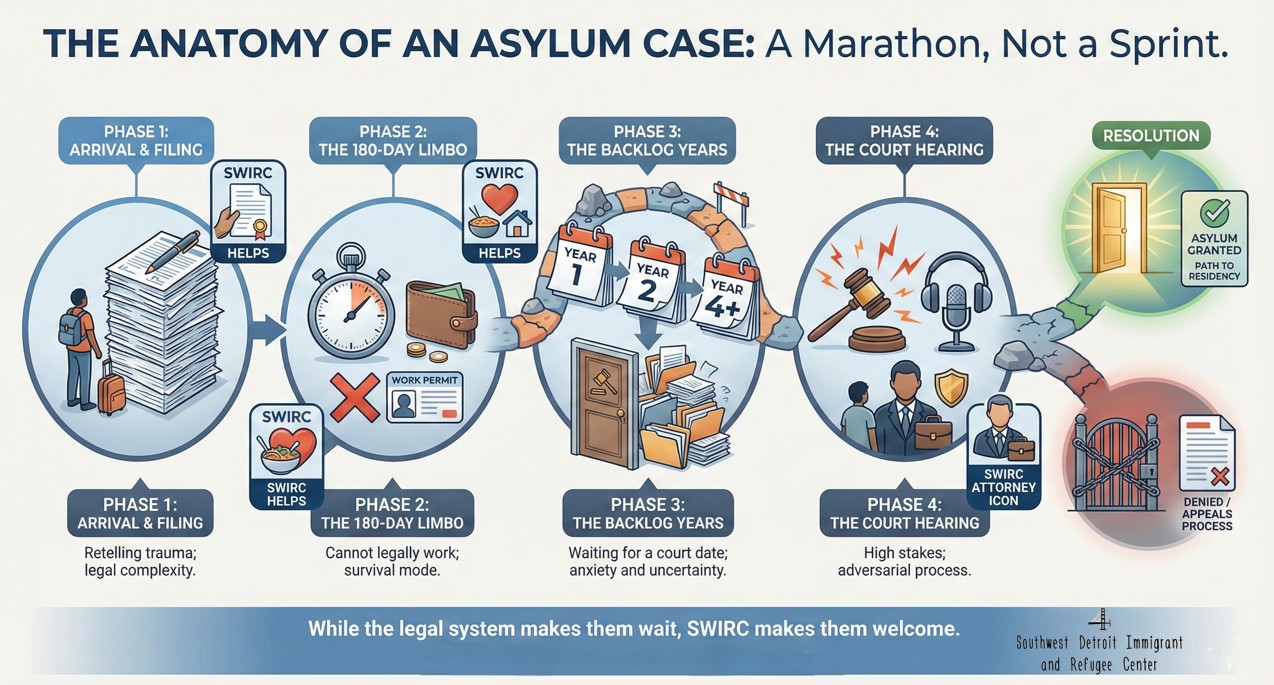
But for the clients we serve at the Southwest Detroit Immigrant and Refugee Center (SWIRC), arriving in Michigan isn’t the finish line. It is the starting line of a complex, high-stakes legal marathon that can last for years.
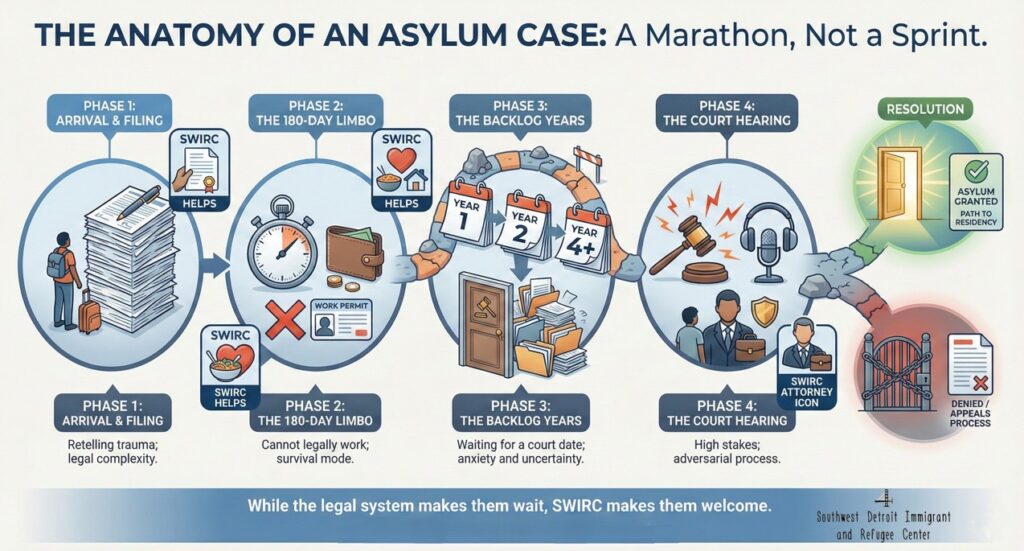
Many of our neighbors are living in a state of legal limbo that is invisible to the average person. To help you understand what they are up against, and where SWIRC steps in, we are breaking down the anatomy of an asylum case.
Phase 1: The Paperwork (Reliving the Trauma)
The process usually begins with Form I-589. It sounds bureaucratic, but it is one of the most emotionally difficult documents a person will ever have to create.
To apply for asylum, a person must prove they have a “well-founded fear of persecution” in their home country. This means they cannot just say they are afraid; they have to document it. They must sit down with us—often relying on interpreters—to create a detailed declaration in English, a language they likely do not speak fluently. This becomes a comprehensive statement of probably the worst things that have ever happened to them.
- The Challenge: One mistranslated word or one confused date can cause a judge to deny a case years later.
- How SWIRC Helps: This is where our legal clinics shine. We provide pro bono legal counsel to ensure that these stories are told accurately, compassionately, and legally. We turn trauma into testimony.
The “Why” Matters: The 5 Protected Grounds
There is a heartbreaking misconception that if you come from a dangerous country, you automatically qualify for asylum. This is not true.
Under U.S. law, fleeing general violence, poverty, or war is often not enough to win a case. To qualify for asylum, you must prove that you are being persecuted specifically because of one of five protected characteristics.
If your persecution isn’t tied to one of these five grounds, the court will likely deny the case:
- Race: You are targeted because of your ethnicity or racial identity.
- Religion: You are targeted for your religious beliefs (or lack thereof).
- Nationality: You are targeted for your citizenship or being from a specific region.
- Political Opinion: You are targeted for your political activities or beliefs (including those the government thinks you hold).
- Membership in a Particular Social Group (PSG): This is the most complex category. It includes groups of people who share a common, immutable characteristic—like gender, family ties, or LGBTQ+ status.
The Reality Check: A client might say, “Gang members threatened to kill me.” To a layperson, that sounds like a clear case. To a judge, it might be rejected as “general criminal violence” unless a lawyer can prove the gang targeted them because of their religion, politics, or social group. SWIRC attorneys act as translators, turning a story of danger into a valid legal argument.
Phase 2: The 180-Day Limbo
Once the application is filed, you might assume the applicant can get a job to support their family. They cannot.
Under current U.S. law, asylum seekers generally must wait 180 days after filing just to become eligible to apply. When you factor in processing times, our clients often face a gap of 6 to 12 months where they are here legally but legally barred from earning a paycheck.
- The Struggle: How do you pay rent, buy winter coats for a Michigan January, or put food on the table when you aren’t allowed to work?
- How SWIRC Helps: While the government clock ticks, SWIRC steps in with community resources. From connecting families to housing support and food distribution programs, we help bridge the gap between “arrival” and “survival.”
Phase 3: The “Great Wait” (The Backlog)
This is the longest phase. Due to massive backlogs in the immigration court system, an asylum seeker in Detroit might file their case in 2026 but not see a judge until 2029 or later.
During these years, they begin to build lives here. Their children learn English in Detroit Public Schools; they become our neighbors and friends. But the anxiety never leaves. They live every day knowing that detention or a single court hearing could strip it all away.
Phase 4: The Day in Court
Eventually, the day arrives. An asylum hearing is an adversarial process. This isn’t just a conversation; there is a government attorney whose job is often to argue against granting asylum.
The statistics are stark: Asylum seekers without a lawyer are overwhelmingly likely to be denied. Those with representation are up to five times more likely to win their case.
- The Stakes: It can mean life or death. They face potential return to a country where they could be imprisoned, tortured, or killed.
- How SWIRC Helps: Justice shouldn’t depend on how much money you have. SWIRC provides high-quality legal representation to those who cannot afford private attorneys, ensuring that due process is a reality, not just a phrase.
A New Year, A Continued Fight
As we look at the year ahead, we know the files on our desks represent real human lives. They are fathers waiting for work permits, mothers waiting for court dates, and children waiting to feel safe.
An asylum case is a marathon. It requires stamina, patience, and resources.
When you support SWIRC as a volunteer or a donor, you aren’t just funding paperwork. You are funding the endurance a family needs to cross the finish line.
How You Can Help This January
- Volunteer: We currently need volunteers for translation, marketing support and fundraising initiatives.
- Donate: Your contributions fund the fees and legal hours that change lives.
- Educate: Share this story. Help your neighbors understand that the “line” to asylum is actually a long, winding road.
La anatomía de un caso de asilo: Por qué la seguridad es un maratón, no un sprint
Se tardan minutos en cruzar una frontera, pero años en navegar el sistema legal. Así es como se ve realmente ese viaje para nuestros vecinos en el suroeste de Detroit.
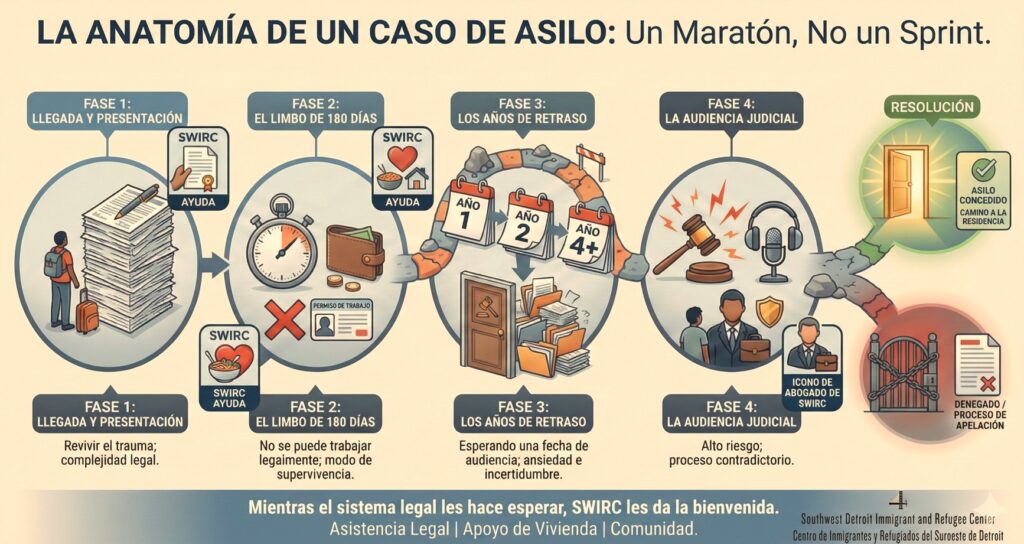
El concepto erróneo común Cuando vemos noticias sobre inmigración, a menudo vemos imágenes de fronteras, aeropuertos o autobuses. Da la impresión de que el “viaje” termina en el momento en que una familia llega a una ciudad como Detroit. Pero para los clientes a los que servimos en el Centro de Inmigrantes y Refugiados del Suroeste de Detroit (SWIRC), llegar a Michigan no es la línea de meta. Es la línea de salida de un maratón legal complejo y de alto riesgo que puede durar años. Muchos de nuestros vecinos viven en un estado de limbo legal que es invisible para la persona promedio. Para ayudarle a comprender a qué se enfrentan y dónde interviene SWIRC, desglosamos la anatomía de un caso de asilo.
Fase 1: El papeleo (Revivir el trauma) El proceso generalmente comienza con el Formulario I-589. Suena burocrático, pero es uno de los documentos más emocionalmente difíciles que una persona tendrá que crear jamás. Para solicitar asilo, una persona debe demostrar que tiene un “temor fundado de persecución” en su país de origen. Esto significa que no pueden simplemente decir que tienen miedo; tienen que documentarlo. Deben sentarse con nosotros —a menudo dependiendo de intérpretes— para crear una declaración detallada en inglés, un idioma que probablemente no hablan con fluidez. Esto se convierte en una declaración completa de probablemente las peores cosas que les han sucedido jamás.
- El desafío: Una palabra mal traducida o una fecha confusa puede hacer que un juez niegue un caso años después.
- Cómo ayuda SWIRC: Aquí es donde brillan nuestras clínicas legales. Brindamos asesoramiento legal pro bono para garantizar que estas historias se cuenten de manera precisa, compasiva y legal. Convertimos el trauma en testimonio.
El “por qué” importa: Los 5 motivos protegidos Existe un concepto erróneo desgarrador de que si vienes de un país peligroso, calificas automáticamente para el asilo. Esto no es cierto. Según la ley de los EE. UU., huir de la violencia general, la pobreza o la guerra a menudo no es suficiente para ganar un caso. Para calificar para el asilo, debe demostrar que está siendo perseguido específicamente debido a una de las cinco características protegidas. Si su persecución no está vinculada a uno de estos cinco motivos, el tribunal probablemente denegará el caso:
- Raza: Usted es atacado debido a su etnia o identidad racial.
- Religión: Usted es atacado por sus creencias religiosas (o la falta de ellas).
- Nacionalidad: Usted es atacado por su ciudadanía o por ser de una región específica.
- Opinión política: Usted es atacado por sus actividades o creencias políticas (incluidas las que el gobierno cree que usted tiene).
- Pertenencia a un grupo social particular (PSG): Esta es la categoría más compleja. Incluye grupos de personas que comparten una característica común e inmutable, como el género, los lazos familiares o el estatus LGBTQ+.
La verificación de la realidad: Un cliente podría decir: “Los miembros de una pandilla amenazaron con matarme”. Para un lego, eso suena como un caso claro. Para un juez, podría ser rechazado como “violencia criminal general” a menos que un abogado pueda probar que la pandilla los atacó debido a su religión, política o grupo social. Los abogados de SWIRC actúan como traductores, convirtiendo una historia de peligro en un argumento legal válido.
Fase 2: El limbo de 180 días Una vez presentada la solicitud, podría asumir que el solicitante puede conseguir un trabajo para mantener a su familia. No pueden. Según la ley actual de los EE. UU., los solicitantes de asilo generalmente deben esperar 180 días después de la presentación solo para ser elegibles para solicitar. Cuando se tienen en cuenta los tiempos de procesamiento, nuestros clientes a menudo enfrentan una brecha de 6 a 12 meses en la que están aquí legalmente pero legalmente impedidos de ganar un sueldo.
- La lucha: ¿Cómo paga el alquiler, compra abrigos de invierno para un enero en Michigan o pone comida en la mesa cuando no se le permite trabajar?
- Cómo ayuda SWIRC: Mientras el reloj del gobierno avanza, SWIRC interviene con recursos comunitarios. Desde conectar a las familias con apoyo de vivienda y programas de distribución de alimentos, ayudamos a cerrar la brecha entre la “llegada” y la “supervivencia”.
Fase 3: La “Gran Espera” (El retraso) Esta es la fase más larga. Debido a los retrasos masivos en el sistema de tribunales de inmigración, un solicitante de asilo en Detroit podría presentar su caso en 2026 pero no ver a un juez hasta 2029 o más tarde. Durante estos años, comienzan a construir vidas aquí. Sus hijos aprenden inglés en las Escuelas Públicas de Detroit; se convierten en nuestros vecinos y amigos. Pero la ansiedad nunca se va. Viven cada día sabiendo que la detención o una sola audiencia judicial podría quitárselo todo.
Fase 4: El día en la corte Eventualmente, llega el día. Una audiencia de asilo es un proceso contradictorio. Esto no es solo una conversación; hay un abogado del gobierno cuyo trabajo es a menudo argumentar en contra de la concesión de asilo. Las estadísticas son claras: los solicitantes de asilo sin abogado tienen una probabilidad abrumadora de ser denegados. Aquellos con representación tienen hasta cinco veces más probabilidades de ganar su caso.
- Lo que está en juego: Puede significar vida o muerte. Se enfrentan a un posible regreso a un país donde podrían ser encarcelados, torturados o asesinados.
- Cómo ayuda SWIRC: La justicia no debería depender de cuánto dinero tengas. SWIRC brinda representación legal de alta calidad a aquellos que no pueden pagar abogados privados, asegurando que el debido proceso sea una realidad, no solo una frase.
Un nuevo año, una lucha continua Al mirar hacia el año que viene, sabemos que los archivos en nuestros escritorios representan vidas humanas reales. Son padres esperando permisos de trabajo, madres esperando fechas en la corte y niños esperando sentirse seguros. Un caso de asilo es un maratón. Requiere resistencia, paciencia y recursos. Cuando apoya a SWIRC como voluntario o donante, no solo está financiando papeleo. Está financiando la resistencia que una familia necesita para cruzar la línea de meta.
Cómo puede ayudar este enero
- Voluntariado: Actualmente necesitamos voluntarios para traducción, apoyo de marketing e iniciativas de recaudación de fondos.
- Donar: Sus contribuciones financian las tarifas y las horas legales que cambian vidas.
- Educar: Comparta esta historia. Ayude a sus vecinos a comprender que la “línea” hacia el asilo es en realidad un camino largo y sinuoso.
